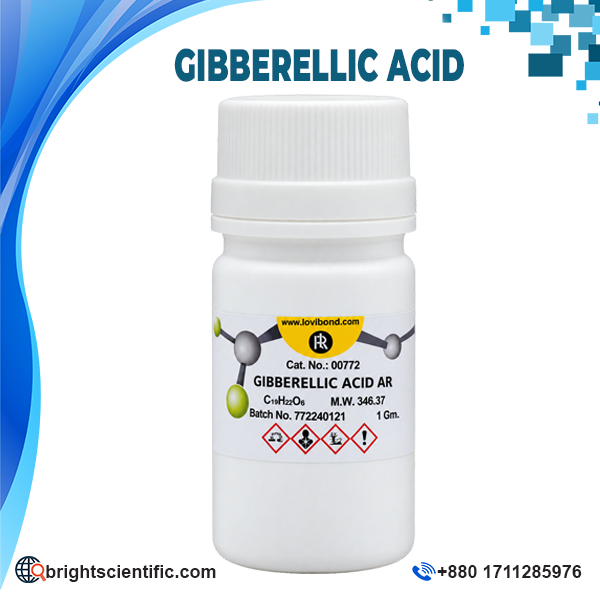
Gibberellic Acid – CAS No. 77-06-5
Gibberellic Acid is a plant growth regulator belonging to the gibberellin group of plant hormones. It is also known as GA3 or Gibberellin A3. This chemical is associated with several important plant growth processes, including seed germination, stem elongation, flowering, and fruit development. It is commonly studied in plant science research and suitable agricultural and horticultural investigations.
Gibberellic Acid is a solid chemical generally described as a white to off-white powder. It is used in laboratory experiments to investigate how plant hormones influence growth and development. Its suitability depends on the requirements of the intended research procedure and the specifications of the supplied product.
M/S Bright Scientific Co. supplies laboratory chemicals and scientific products in Bangladesh. Contact Bright Scientific to enquire about the current price, available pack sizes, stock status, and delivery options for Gibberellic Acid.
Product Specifications
- Product Name: Gibberellic Acid
- CAS Number: 77-06-5
- Molecular Formula: C₁₉H₂₂O₆
- Molecular Weight: 346.38 g/mol
- Synonyms: GA3, Gibberellin A3
- Physical State: Solid
- Appearance: White to off-white powder
- Odour: Odourless
- Melting Point: Approximately 225–227°C
- Product Category: Laboratory Chemical / Plant Growth Research Chemical
Confirm the supplied product’s label and batch-specific documentation before use, as specifications may vary between products and suppliers.
Applications of Gibberellic Acid
1. Plant Growth Research
Gibberellic Acid is used in plant physiology research to investigate the role of plant hormones in growth and development. Researchers may study its effects on stem elongation, shoot development, and other growth-related responses under controlled experimental conditions.
2. Seed Germination Studies
GA3 is frequently studied in experiments involving seed dormancy and germination. Depending on the plant species and experimental conditions, gibberellins can help regulate processes associated with breaking dormancy and initiating seed growth. The appropriate concentration and treatment method should be determined according to a validated research protocol.
3. Agricultural and Horticultural Research
Gibberellic Acid may be investigated in agricultural and horticultural studies to understand its influence on plant development. Responses can vary according to plant species, growth stage, environmental conditions, and application method. Practical applications should follow relevant technical guidance and applicable local regulations.
4. Fruit Development Studies
Researchers may use GA3 in experiments examining fruit growth, development, and related characteristics. Its effects depend on the crop, concentration, application timing, and growing conditions. Therefore, researchers should follow reliable technical instructions when planning experiments.
5. Educational and Laboratory Experiments
Universities, colleges, agricultural institutes, and plant science laboratories may use Gibberellic Acid in suitable experiments involving plant hormones. Before use, verify that the chemical specifications meet the requirements of the intended laboratory procedure.
Frequently Asked Questions (FAQ)
1. What is Gibberellic-Acid?
Gibberellic-Acid is a plant hormone from the gibberellin group. It is also known as GA3 or Gibberellin A3.
2. What is the CAS number of Gibberellic-Acid?
The CAS Registry Number is 77-06-5.
3. What is the molecular formula of Gibberellic-Acid?
Its molecular formula is C₁₉H₂₂O₆.
4. What is the molecular weight of Gibberellic-Acid?
Its molecular weight is 346.38 g/mol.
5. What is Gibberellic-Acid used for?
It is studied in plant science research involving seed germination, plant growth, and fruit development.
6. What is the appearance of Gibberellic-Acid?
It is generally described as a white to off-white powder. Check the supplied product label for confirmation.
7. Where can I buy Gibberellic-Acid in Bangladesh?
You can contact M/S Bright Scientific Co. to enquire about current price and availability.
8. How should Gibberellic-Acid be stored?
Keep it in a properly closed container and follow the storage instructions on the product label and Safety Data Sheet.
9. What safety precautions should be followed?
Use appropriate protective equipment, avoid eye and skin contact, and follow the applicable SDS and laboratory safety procedures.
10. What should I check before ordering?
Confirm the product name, CAS number, required quantity, packaging, and specifications to ensure the product meets your laboratory needs.