
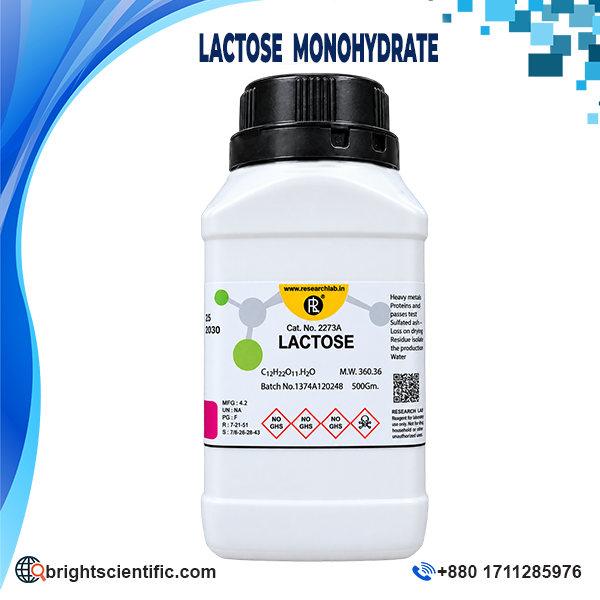

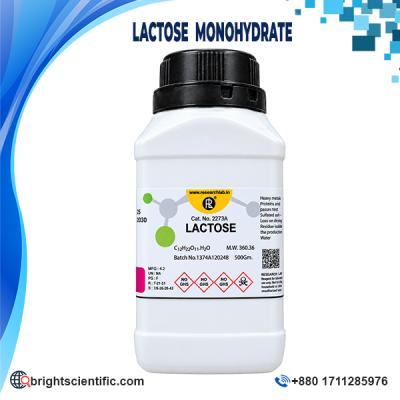
Lactose Monohydrate – Analytical Standard, 500mg
Lactose Monohydrate Analytical Standard (47287-U) is a reference-grade carbohydrate standard used in analytical chemistry, food analysis, and laboratory testing. Also known as milk sugar or α-Lactose Monohydrate, this compound is suitable for analytical procedures where a defined chemical reference material is required.
Supplied under the Supelco product range, this analytical standard is intended for professional laboratory use. It is particularly relevant to food and beverage analysis and is listed as suitable for High-Performance Liquid Chromatography (HPLC) and Gas Chromatography (GC) applications. The manufacturer provides a Certificate of Analysis (CoA) to support product identification and batch-specific quality documentation.
Product Description
Lactose Monohydrate is a disaccharide composed of glucose and galactose, with one molecule of water of crystallisation. It is naturally associated with milk and dairy products and is commonly referred to as milk sugar.
The analytical standard has the empirical formula C₁₂H₂₂O₁₁·H₂O, a CAS number of 5989-81-1, and a molecular weight of 360.31 g/mol. It is supplied in neat form in a 500mg ampoule, making it suitable for analytical laboratories requiring a small quantity of a defined reference material.
For accurate analytical work, users should consult the product-specific Certificate of Analysis for applicable batch information and verify suitability for their validated method.
Key Features and Benefits
- Product Name: Lactose Monohydrate
- Product Number: 47287-U
- Grade: Analytical Standard
- CAS Number: 5989-81-1
- Molecular Formula: C₁₂H₂₂O₁₁·H₂O
- Molecular Weight: 360.31 g/mol
- Pack Size: 500mg
- Packaging: Ampoule
- Format: Neat
- Suitable Techniques: HPLC and GC
- Application Area: Food and beverage analysis
- Storage Temperature: 2–30°C
- Documentation: Certificate of Analysis (CoA) available
Applications of Lactose Monohydrate Analytical Standard
1. Food and Beverage Analysis
Lactose Monohydrate is relevant to analytical testing involving lactose and carbohydrate composition in food and dairy products. Laboratories may use suitable reference standards to support method development, analytical comparisons, and quality-control procedures.
2. HPLC Analysis
The product is listed as suitable for HPLC. This technique can be used in validated analytical methods for separating and measuring chemical components. The exact sample preparation, detector, and analytical conditions depend on the method being followed.
3. Gas Chromatography
The manufacturer also lists GC suitability. Gas chromatography methods for carbohydrates may require specific derivatisation or sample preparation. Users should confirm the product’s suitability against the requirements of their analytical procedure.
4. Research and Quality Control
Analytical laboratories and research institutions may use this material in studies involving lactose identification and carbohydrate analysis. Batch documentation helps users verify the identity and relevant quality information of the material.
Storage and Handling
Store the product within the manufacturer’s specified temperature range of 2–30°C. Keep it in its original container and protect it from contamination and unsuitable storage conditions. Follow the product label and Safety Data Sheet (SDS), and use appropriate laboratory personal protective equipment.
For quantitative analysis, consult the Certificate of Analysis and follow the validated method rather than assuming a particular purity or certified concentration that is not stated in the product specifications.
Frequently Asked Questions (FAQ)
1. What is Lactose Monohydrate Analytical Standard?
It is an analytical-grade reference material used in laboratory procedures involving lactose and carbohydrate analysis.
2. What is the product number?
The product number is 47287-U.
3. What is the CAS number?
The CAS number is 5989-81-1.
4. What is the molecular weight?
The molecular weight is 360.31 g/mol.
5. What is the pack size?
The listed package contains 500mg (0.5g) in an ampoule, not 500gm.
6. Is it suitable for HPLC?
Yes. The manufacturer lists it as suitable for HPLC. Confirm compatibility with your specific analytical method.
7. Can it be used for food analysis?
Yes. Food and beverage analysis is listed as an application area.
8. How should it be stored?
Store at 2–30°C and follow the product label and manufacturer’s handling instructions.
9. Is a Certificate of Analysis available?
Yes. The manufacturer indicates that the current Certificate of Analysis can be downloaded. Check the document corresponding to the supplied lot or batch.
LABORATORY USE ONLY, NO ANOTHER USE.


Reviews
There are no reviews yet.